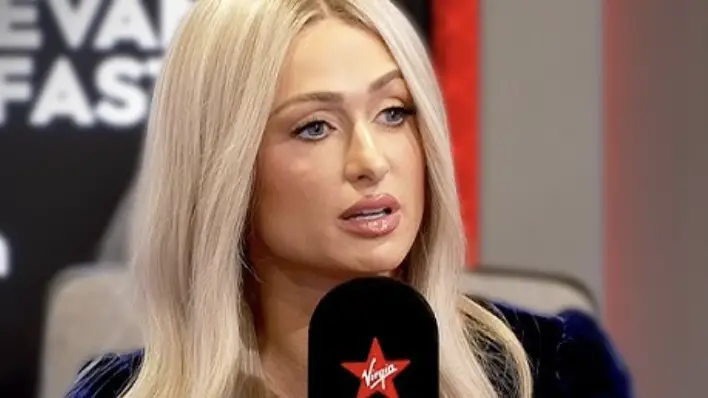
Paris Hilton has publicly rejected a long-running allegation that Ghislaine Maxwell once tried to recruit her for Jeffrey Epstein, saying she has no memory of ever meeting Maxwell and suggesting her name has been used to generate attention around the case.
The American businesswoman and media personality addressed the claim in a recent interview with The Sunday Times, after it re-emerged from a 2020 television documentary about Epstein’s crimes. Asked about the allegation that Maxwell had singled her out at a party when she was a teenager, Hilton replied: “I don’t even remember ever meeting her.” She added: “I’m such a good clickbait name.”
The comments represent Hilton’s first direct response to a story that has circulated for several years in coverage of Epstein and Maxwell. The allegation was first made in the Lifetime docuseries Surviving Jeffrey Epstein, which examined the late financier’s abuse of underage girls and women and the role prosecutors say Maxwell played in that network. In the programme, British journalist Christopher Mason, a former acquaintance of Maxwell, recalled an incident at a party around the year 2000 when he said Maxwell appeared to take a sudden interest in a young woman in the room.
“A friend of mine was at a party and Ghislaine said, ‘Oh my God, who’s that?’ and was looking at this pretty, young, sort of teenage girl,” Mason said in the documentary. “And she said, ‘Do you know her?’ My friend said, ‘Yes, she’s called Paris Hilton.’ And Ghislaine said, ‘God, she’d be perfect for Jeffrey. Could you introduce us?’”
In the same episode, viewers were shown a photograph taken at a New York fashion event in September 2000, depicting Hilton standing next to Maxwell and Donald Trump. Hilton was 19 at the time and had recently signed to a modelling agency then owned by Trump. Mason’s account did not state whether an introduction between Hilton and Epstein ever took place, and there is no suggestion in the documentary that Hilton had any involvement with Epstein’s criminal activities.
Hilton’s new remarks make clear that, from her perspective, any encounter with Maxwell left little impression and that she rejects the idea that she was on the verge of being drawn into Epstein’s circle. By saying she does not remember meeting Maxwell, she has distanced herself from the socialite who was later convicted of sex trafficking offences in connection with Epstein. Her additional comment about being a “clickbait name” indicates she believes her celebrity has led to her being invoked in stories that attract public attention to the wider scandal.
Maxwell, the daughter of the late British media owner Robert Maxwell, was for years a prominent figure in transatlantic social circles. Prosecutors later said that behind the glamorous public image, she was acting as Epstein’s key facilitator, recruiting and grooming underage girls for him to abuse at homes in New York, Florida and elsewhere between 1994 and 2004. In 2021 a New York jury found her guilty on five counts, including sex trafficking of a minor, and she was sentenced the following year to 20 years in prison.
Court documents and victim testimony described how Maxwell used parties, social events and her connections in the fashion and modelling worlds to identify girls and young women whom Epstein could exploit. Survivors told the court that Maxwell befriended them, sometimes presenting Epstein as a benefactor or mentor, and then helped to arrange meetings that escalated into abuse. It is within that pattern of alleged behaviour that Mason’s account of Maxwell’s interest in a teenage Hilton has been framed.
Epstein himself had faced scrutiny for years before his final arrest in 2019. He pleaded guilty in Florida in 2008 to state charges of procuring an underage girl for prostitution and was required to register as a sex offender, but served a relatively short custodial sentence under a controversial plea deal. Federal prosecutors later said that agreement had shielded him from wider federal prosecution at the time. In July 2019 he was arrested again, this time on federal sex-trafficking charges alleging that he abused dozens of minor girls at his properties in New York and Florida. The following month he was found dead in his cell at a Manhattan jail, with the death ruled a suicide.
The scale of Epstein’s crimes, the influence of some of the people who associated with him and the questions left unanswered by his death have all contributed to continuing public interest in the case. The resurfacing of Mason’s allegation about Hilton came amid renewed attention on Epstein’s connections with political leaders, financiers and celebrities, following the release of thousands of pages of court records and correspondence from civil litigation linked to his estate.
Hilton’s name entered that discussion only tangentially, via the documentary account of Maxwell’s alleged comments and the photograph from the fashion event. The hotel heiress and reality-television star was at the time in the early stages of a career that would soon make her one of the most recognisable figures in pop culture, first through socialite party coverage and later through the reality show The Simple Life.
In recent years Hilton has worked to recast her public image, describing how the persona that made her famous in the early 2000s was, in her words, a character designed to entertain and to shield her from earlier trauma. She has spoken at length about alleged abuse she says she suffered as a teenager at privately run “emotional-growth” boarding schools in the United States, testimony that helped fuel a movement to regulate youth-treatment facilities. She has produced and fronted documentaries, lobbied for legislative reform and testified in Congress about the need to protect teenagers in institutional settings.
Those experiences have informed how some supporters interpret her response to the Maxwell allegation. Hilton has repeatedly positioned herself on the side of survivors of abuse, and she has made clear that she wants to control how her own story is told. In rejecting the idea that Maxwell had targeted her, she is not disputing the accounts of Epstein’s victims, but rather setting a boundary around the way her name has been used in connection with the case.

Mason’s original remarks in Surviving Jeffrey Epstein were presented as second-hand, relaying what he said a friend had witnessed at the party where Maxwell allegedly saw Hilton. He did not claim to have heard Maxwell speak directly to Epstein about Hilton, nor did he allege that any approach to Hilton ever took place. The docuseries used the anecdote to illustrate how, according to acquaintances, Maxwell moved through social events on the lookout for potential recruits.
The party itself has been linked publicly to New York’s fashion and nightlife scene at the turn of the millennium, when Hilton was beginning to attract attention as a young heiress and aspiring model. At that time she was represented by T Management, a modelling agency owned by Trump, placing her in the same social circles as older, powerful figures in business and entertainment. The photograph later highlighted in the documentary, showing Hilton alongside Maxwell and Trump, was taken at a fashion show in September 2000, according to reports.
Hilton’s remarks to The Sunday Times do not directly address the photograph or the precise setting of the alleged encounter, but her statement that she does not remember meeting Maxwell is unambiguous. Nor has she suggested that Mason fabricated his account; instead her focus has been on her own lack of recollection and on the broader point that her fame makes her a convenient reference point in stories about notorious figures. “I’m such a good clickbait name,” she said.
While her comments were brief, they come at a time when the Epstein and Maxwell cases remain highly sensitive subjects. Survivors continue to call for full transparency about who knew what and when, and campaigners have pressed for all remaining investigative files to be made public. In the United States, lawmakers have debated efforts to ensure that extensive documentation gathered by authorities is unsealed, amid speculation about the degree to which high-profile individuals may have been aware of, or complicit in, Epstein’s conduct.
Hilton’s intervention does not shed new light on those unresolved questions, but it does clarify her own position in relation to the rumour that has circulated about her for five years. Her denial of any memory of Maxwell, and her suggestion that the story has persisted in part because of the commercial value of her name, underline the complexities of public narratives around the Epstein case, in which the lives and images of many people, including those never accused of wrongdoing, have intersected with one of the most notorious abuse scandals of recent decades.