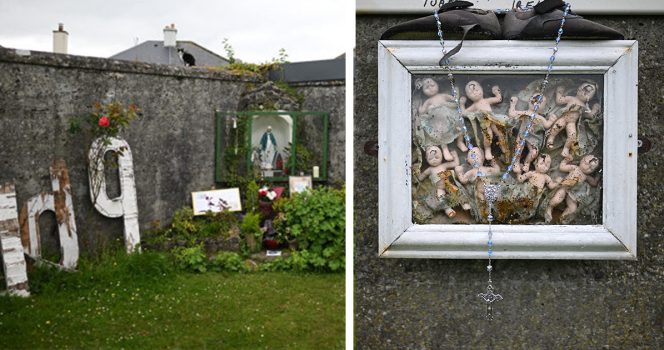
A second burial site has been discovered at a residence in Ireland that was previously operated by Catholic nuns for unwed mothers, following reports suggesting that the remains of nearly 800 infants may be interred there.
Earlier this year, we reported that a forensic team commenced the excavation of a former “mother and baby home” in Tuam, Ireland, in search of the remains of nearly 800 babies and children.
This grim operation was set to occur at the location where the home – which ceased operations over 60 years ago – once existed, after it was disclosed that as many as 798 children perished there between 1925 and 1961.
According to new information from the New York Post, “consistent evidence” of a second burial site was discovered following the recent excavation.
“There were no surface or ground level indications of the possibility of a burial ground at this location prior to excavation,” the group stated in a release.

The second burial site is reported to be situated between 55 and 105 yards from a septic tank where the remains of 796 infants born to unwed mothers were thought to have been disposed of.
The newly found remains, located in coffins, have been forwarded for forensic analysis, as stated by the Office of the Director of Authorized Intervention. Director Daniel MacSweeney disclosed that to date, 160 individuals have reached out to the office to provide DNA samples, hoping to identify the remains.
According to The Guardian, Catherine Corless, a local historian in County Galway, Ireland, was the first to raise concerns about the tragic history of the baby home. Corless’ preliminary research revealed the names of 798 infants believed to have been interred there.
“There are so many babies, children just discarded here,” Corless remarked to Agence France-Presse.
Corless claims that numerous young individuals who perished at the institution were disposed of in a septic tank known as “the pit.” Only two of the alleged 798 children received formal burials in a nearby cemetery, while the remainder are believed to rest in a mass grave, lacking coffins or gravestones, and with no documentation of their interment.

At the home, women and girls were separated from their newborns, who were subsequently raised by nuns until they were adopted, often without the mothers’ awareness.
The Post reports that some of the children were sent as far away as the United States, Canada, or Australia. Hundreds of others did not survive.
In 2015, the Irish government initiated an investigation into 14 mother and baby homes and four county homes throughout Ireland, including Tuam.
In an interview with Sky News, Corless, whose relentless efforts led to the establishment of the investigation into the homes, expressed earlier this year: “I’m feeling very relieved.
“It’s been a long, long journey. Not knowing what’s going to happen, if it’s just going to fall apart or if it’s really going to happen.”
The Sisters of Bon Secours, a Catholic religious order that managed the Tuam home, extended their “profound apologies.” However, Corless continues to struggle with the understanding of how such inhumanity could occur.
“The church preached to care for the vulnerable, the elderly, and the orphaned, yet for some inexplicable reason, they excluded illegitimate children from their own moral considerations,” she remarked.
“I can never comprehend how they could inflict such harm on innocent babies and toddlers. Beautiful, vulnerable children.”